
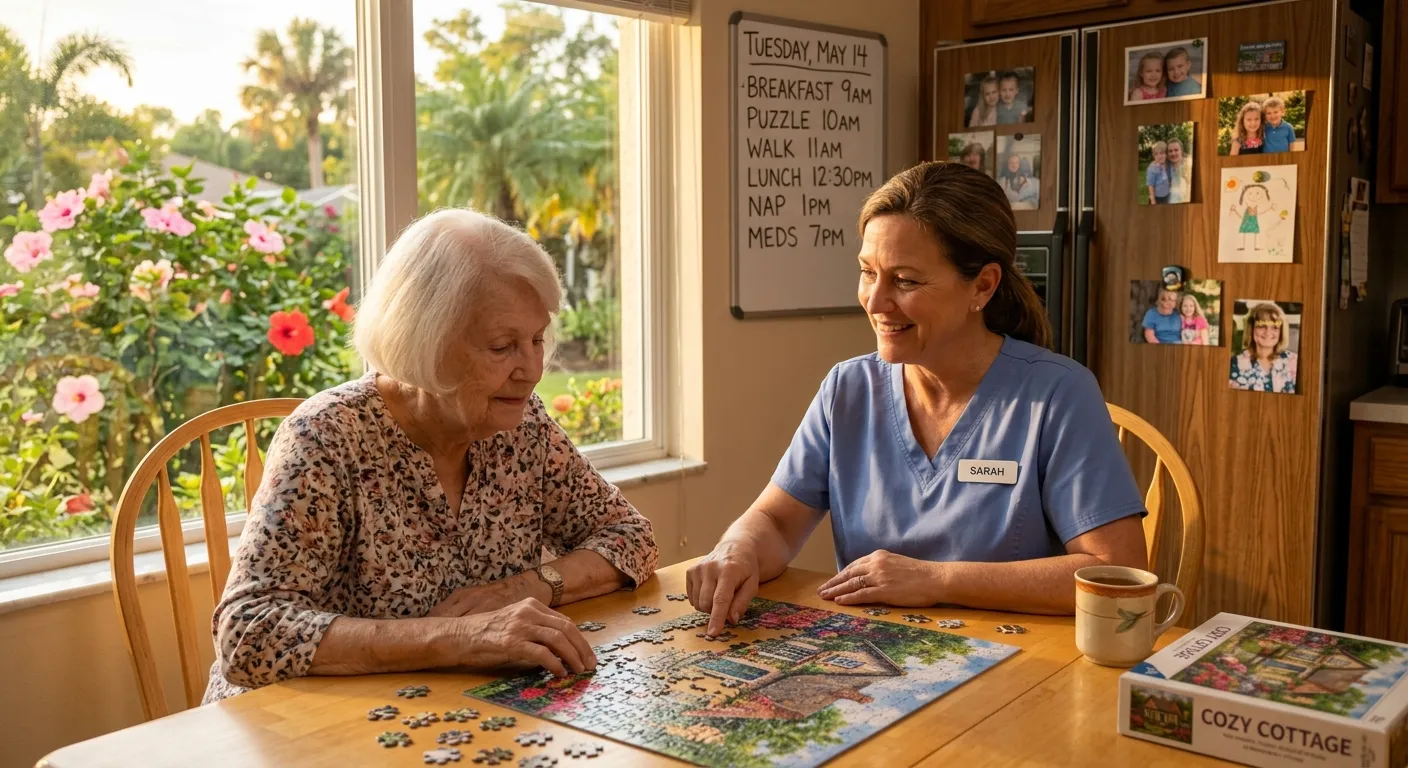
Home Health Care for Dementia Patients in Florida
More than 580,000 Floridians are living with dementia, and that number is projected to reach 720,000 by 2030 according to the Alzheimer's Association. For most families, keeping a loved one at home as long as possible is the goal. Home health care can make that possible by bringing trained professionals into the home to assist with daily activities, evaluate safety risks, and support family caregivers who are often managing everything on their own.
This guide covers when to consider starting home health services, what types of dementia-focused support are available through Florida agencies, how to find providers with dementia-trained staff, what Medicare covers versus private pay options, and how to use our directory and CMS star ratings to compare agencies near you. For condition-specific guidance, see our detailed guides on home health care for Alzheimer's patients and home health care for Parkinson's patients, which cover the unique therapy and care coordination needs for each diagnosis.
When Should Families Consider Home Health for Dementia?
One of the most common questions families ask is: "When is the right time?" The answer is almost always earlier than you think. Many families wait until a crisis occurs (a fall, a hospitalization, or a dangerous wandering incident) before seeking help. By that point, the patient and caregiver are both under significant stress.
Consider reaching out to a home health agency when you notice any of these situations:
- Your loved one is forgetting medications, skipping meals, or leaving the stove on.
- Bathing, dressing, or grooming has become difficult or is being refused.
- There have been falls or near-falls in the home.
- The primary caregiver is feeling exhausted, anxious, or isolated.
- Your loved one was recently discharged from the hospital and needs follow-up care at home.
- You are unsure whether the home environment is safe for someone with worsening memory loss.
Starting early gives the home health team time to assess the home for safety hazards, train caregivers on effective communication and daily care techniques, and build a relationship with the patient while they can still participate in their own care plan. A physician can write a referral order at any stage of dementia if skilled care needs are present.
What Dementia-Related Services Do Florida Home Health Agencies Offer?
Florida's Medicare-certified home health agencies offer a range of services that can be tailored to the needs of dementia patients. Here is what families should know about each one.
Home Health Aide Assistance
Home health aides provide the hands-on, day-to-day support that many dementia patients need. This includes help with bathing, grooming, dressing, and toileting, as well as meal preparation, light housekeeping in the patient's care area, and companionship. For families who are providing care around the clock, aide visits offer essential relief. Under Medicare, aide services are available when the patient is also receiving skilled nursing or therapy.
Safety Assessments and Home Modifications
Occupational therapists are trained to evaluate a home through the lens of cognitive impairment. They look for hazards that would not be a concern for someone without memory loss: unlocked doors leading to busy streets, accessible cleaning products, confusing room layouts, and trip hazards. Based on the assessment, an OT can recommend door alarms, stove shut-off devices, simplified room labels, and grab bars. They also train caregivers on how to assist with daily activities in ways that preserve the patient's dignity and reduce resistance.
Caregiver Training and Education
Skilled nurses play a key role in educating family caregivers about what to expect as dementia progresses. This includes guidance on managing medications (especially when a patient takes multiple prescriptions for co-occurring conditions), recognizing signs of infection or pain that the patient may not be able to communicate, and understanding behavioral changes like agitation or sundowning. Caregiver training is one of the most valuable services home health provides, and it can qualify as a skilled care need under Medicare.
Fall Prevention and Mobility Support
Physical therapists address the balance and mobility challenges that make falls a leading danger for people with dementia. A PT can design simple exercises that fit into the patient's daily routine, recommend assistive devices, and identify environmental changes that reduce fall risk. Because dementia patients may not follow traditional exercise instructions, therapists adapt their approach to match the patient's cognitive abilities.
Community Resource Connections
Medical social workers through your home health agency can connect your family with local support networks. In Florida, these include the Alzheimer's Association chapters (with a 24/7 helpline at 1-800-272-3900), Area Agencies on Aging, adult day programs, respite care services, and Memory Disorder Clinics operated by the Florida Department of Elder Affairs. Social workers can also help families navigate Medicaid applications and long-term care planning.
How to Find Agencies with Dementia-Trained Staff
Not every home health agency has the same level of experience with dementia patients. When searching for the right provider, these steps can help you identify agencies that are well-equipped for dementia care.
Browse your city's agency listings. Start by searching our directory for Miami, Tampa, Orlando, or whichever Florida city your loved one lives in. Each listing shows the agency's services offered, CMS quality star ratings, and patient survey scores.
Ask about dementia-specific training. When you call agencies, ask whether their aides and nurses have completed any dementia care certification programs (such as those offered by the Alzheimer's Association). Ask whether they assign consistent staff members to dementia patients rather than rotating aides, since familiarity and routine matter greatly for someone with memory loss.
Inquire about their approach to common challenges. A good dementia care provider will have clear answers about how they handle wandering risks, resistance to personal care, agitation, and sundowning. If an agency cannot speak to these topics with confidence, they may not have deep experience serving this population.
Compare CMS star ratings. Every Medicare-certified agency in our directory displays quality of care and patient satisfaction star ratings from CMS.gov. While these ratings do not specifically measure dementia expertise, agencies with high scores across the board tend to deliver stronger care for all patient types. Use our Agency Comparison Builder to view agencies side by side.
What Medicare Covers vs. Private Pay
Understanding what Medicare will and will not cover is one of the first steps in planning dementia home health care.
What Medicare Covers
Medicare covers home health care for dementia patients when they meet the standard eligibility requirements: the patient must be homebound, need skilled care (nursing or therapy), have a physician's order, and receive services from a Medicare-certified agency. A dementia diagnosis alone does not automatically qualify someone. However, most dementia patients do qualify because they have co-occurring conditions like diabetes, heart disease, or recent fall injuries that require skilled nursing or therapy.
Importantly, skilled nursing for medication management, caregiver training, and safety assessments related to dementia can also meet the skilled care requirement. When Medicare covers the skilled service, it also covers home health aide visits as part of the care plan at no cost to the patient. Use our Medicare Eligibility Explainer tool to check whether your loved one may qualify.
When Private Pay or Medicaid May Be Needed
Medicare's home health benefit is intermittent, meaning it covers periodic skilled visits rather than around-the-clock care. For families that need daily aide assistance, extended companionship, or overnight supervision, private pay home care may be necessary. In Florida, private pay rates for home health aides typically range from $25 to $35 per hour depending on the region. Use our Home Health Cost Estimator to get a ballpark figure for your area.
Florida Medicaid's Statewide Medicaid Managed Care (SMMC) Long-Term Care program can cover personal care attendants, adult day care, and caregiver respite for eligible patients. Qualifying for Medicaid depends on income and asset limits, and a medical social worker from your home health agency can help with the application process.
Using Our Directory to Evaluate Agencies
Our directory lists over 1,100 Medicare-certified home health agencies across Florida, all sourced from official CMS data. Here is how to make the most of it when searching for dementia care.
- Search by city. Navigate to your loved one's city page to see all agencies serving that area, complete with star ratings, phone numbers, and services offered.
- Filter by services. Look for agencies that offer the combination your family needs, such as skilled nursing plus home health aide services plus occupational therapy.
- Review star ratings. Pay attention to both the quality of care rating (based on patient outcomes) and the patient survey rating (based on family satisfaction). Both matter when choosing dementia care.
- Compare side by side. Use the Agency Comparison Builder to place your top choices next to each other and see how they stack up on the metrics that matter most.
- Call and ask questions. Star ratings tell part of the story. Your phone conversations with agency staff will reveal whether they truly understand dementia care.
Helpful Tools
Use our free tools to make informed decisions about home health care in Florida:
- Home Health Cost Estimator — Get Florida-specific pricing for home health services
- Agency Comparison Builder — Compare up to 3 agencies side by side
- Home Care Fit Quiz — Find out which type of care is right for your situation
- Medicare Eligibility Explainer — Check if you qualify for Medicare home health
- Discharge Readiness Checklist — Prepare for a safe transition home from the hospital
Frequently Asked Questions
When should families start home health care for a loved one with dementia?
Families should consider starting home health care when a loved one with dementia begins showing safety concerns such as forgetting to turn off the stove, missing medications, or having trouble with balance and mobility. Other signs include the primary caregiver feeling overwhelmed, the person needing help with bathing or dressing, or a recent hospitalization. You do not need to wait for a crisis. Starting early allows a home health team to conduct safety assessments, train caregivers, and establish routines before the disease progresses further. A physician can write the referral order at any stage if skilled care needs are present.
What home health services are available for dementia patients in Florida?
Florida home health agencies can provide several services for dementia patients. These include home health aide assistance with bathing, grooming, and daily activities; skilled nursing for medication oversight and caregiver education; occupational therapy for home safety assessments and adaptive strategies; physical therapy for fall prevention and mobility support; speech therapy for communication and swallowing difficulties; and medical social work to connect families with local resources like the Alzheimer's Association and Area Agencies on Aging. The specific combination of services depends on the patient's needs and what their physician orders.
How do I find home health agencies with dementia-trained staff in Florida?
Start by using our directory to browse Medicare-certified agencies in your city, then filter by the services you need (such as aide assistance or skilled nursing). Check each agency's CMS quality star ratings and patient survey scores for overall performance. When contacting agencies, ask whether their staff have completed dementia-specific training programs, whether they assign consistent aides rather than rotating staff, and how they handle common dementia-related challenges. Agencies that specialize in or frequently serve dementia patients will be able to answer these questions in detail.
Does Medicare cover home health care for someone with dementia?
Medicare covers home health care for dementia patients when they meet the standard eligibility requirements: homebound status, a need for skilled care such as nursing or therapy, a physician's order, and services from a Medicare-certified agency. A dementia diagnosis alone does not automatically qualify someone. However, most dementia patients have co-occurring conditions (diabetes, heart disease, fall injuries) that do qualify. Skilled nursing for medication management, caregiver training, and safety assessments related to dementia can also meet the skilled care requirement. For services Medicare does not cover, families can explore private pay or Medicaid options.
How can I use CMS star ratings to compare dementia care agencies?
CMS assigns quality star ratings (1 to 5 stars) to Medicare-certified home health agencies based on patient outcomes and satisfaction data. When comparing agencies for dementia care, pay close attention to the patient survey star rating, which reflects how patients and families rated their experience. Also review the quality of care star rating, which measures outcomes like improvement in mobility and timely initiation of care. Our directory displays both ratings on every agency profile so you can compare side by side. While star ratings do not specifically measure dementia expertise, agencies with consistently high scores tend to deliver better care across all patient populations.