
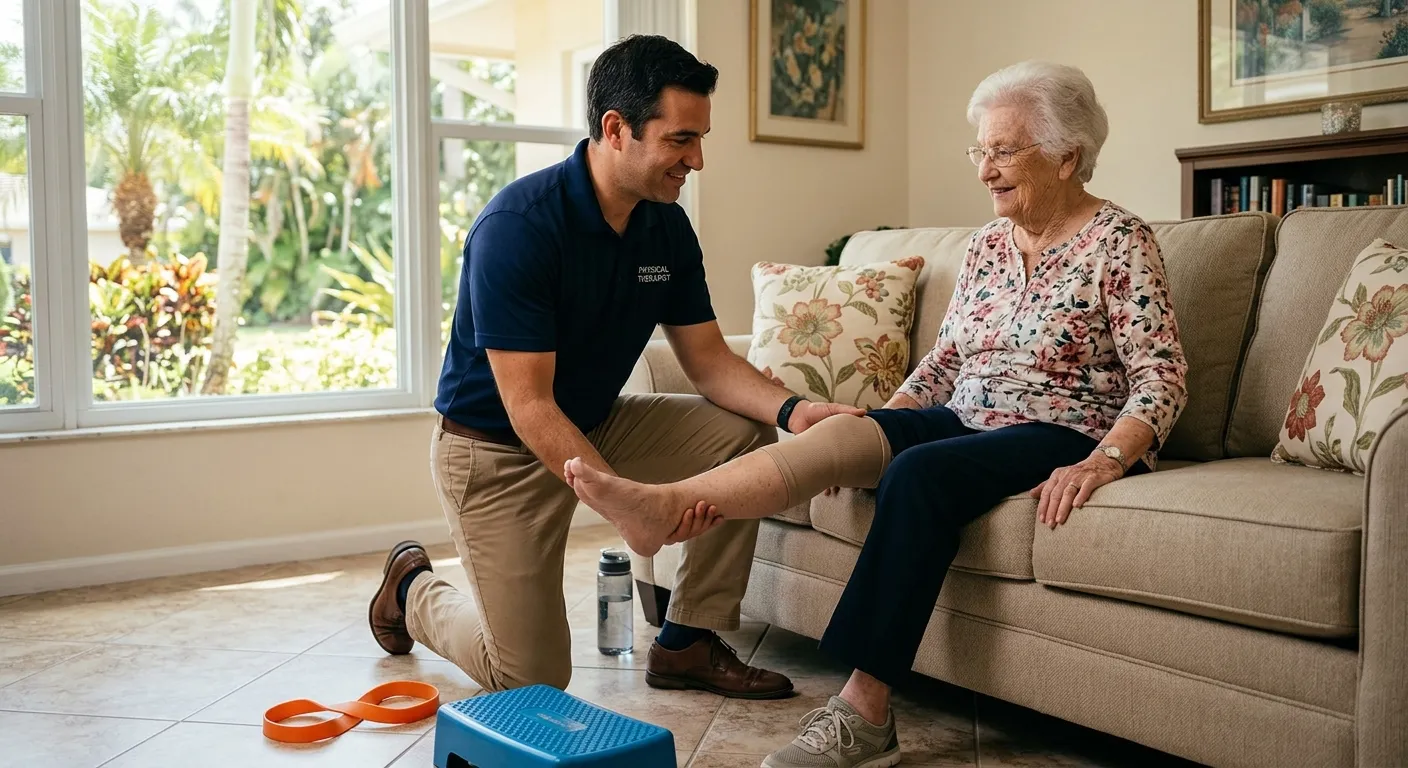
Home Health Care After Knee Replacement in Florida
If you or a family member is preparing for knee replacement surgery in Florida, one of the biggest questions is: what happens when you get home? The hospital stay is usually just one or two days. After that, a home health team takes over, visiting your home to help with wound care, physical therapy, and the daily challenges of recovering with a new knee. With over 1,100 Medicare-certified home health agencies across Florida, you have real choices when it comes to the care team that walks through your door.
This guide covers what types of home health visits to expect, how often they happen, how long services typically last, what Medicare pays for, and how to find an agency with strong orthopedic rehab experience. If you are also considering hip replacement, see our companion guide on home health care after hip replacement. For a broader overview covering all procedure types, read our general guide to home health care after surgery.
What Types of Home Health Visits to Expect
After knee replacement, your home health plan will typically include visits from two or three different types of providers. Each one plays a specific role in helping you recover safely at home.
Physical Therapy Visits
Physical therapy is the cornerstone of knee replacement recovery at home. A licensed physical therapist will come to your house to work with you on regaining strength and mobility in the affected leg. Visits are most frequent in the first two weeks (three to five times per week) and gradually taper as you become more independent. Each session typically lasts 45 to 60 minutes. Your therapist will also give you a daily home exercise program to follow between visits, which is just as important as the sessions themselves.
Skilled Nursing Visits
Skilled nursing visits focus on monitoring your surgical wound, checking for signs of infection, and managing medications such as blood thinners. A registered nurse will typically visit two to three times per week during the first two weeks, then taper to once a week or less as your incision heals. Nurses also coordinate with your surgeon's office if any concerns come up between your scheduled follow-up appointments.
Occupational Therapy Visits
An occupational therapist helps you handle everyday tasks safely while your knee heals. This includes getting dressed, bathing, using the bathroom, and moving around your kitchen. OT visits are usually less frequent (one to two times per week) and focus on practical strategies and adaptive equipment that make daily life manageable during recovery.
How Often Do Home Health Visits Happen?
Visit frequency changes as your recovery progresses. Here is a general idea of what to expect, though your actual schedule will depend on your surgeon's orders and how quickly you heal.
- Weeks 1 to 2: The most intensive period. Physical therapy three to five times per week, skilled nursing two to three times per week, and occupational therapy one to two times per week.
- Weeks 3 to 4: Visits begin to decrease. Physical therapy drops to two or three times per week, nursing visits taper to once a week, and OT may wrap up entirely.
- Weeks 5 to 6: Most patients are nearing the end of home health services. Physical therapy may continue once or twice per week before you transition to outpatient therapy or an independent exercise routine.
In total, most patients receive somewhere between 15 and 30 home health visits over the full course of their recovery. Your agency will set up the schedule based on your doctor's plan of care.
How Long Does Home Health Last After Knee Replacement?
For most patients, home health care lasts three to six weeks. The timeline depends on several factors: your overall health before surgery, how well you respond to therapy, and whether you have any complications like wound healing issues or blood clots. Younger, healthier patients sometimes wrap up in three weeks. Patients with other health conditions may need the full six weeks or longer.
Medicare covers home health in 60-day episodes, so if your doctor determines you still need skilled care after the initial period, your agency can continue services without a gap. Your home health team will communicate with your surgeon throughout the process and help you plan the transition, whether that means moving to outpatient physical therapy, joining a gym-based rehab program, or continuing exercises on your own.
Finding an Agency with Orthopedic PT Experience
Not all home health agencies are the same when it comes to post-surgical orthopedic rehab. The physical therapist who visits your home will have a significant impact on your recovery, so it is worth spending time choosing the right agency. Here are some practical steps.
- Ask your surgeon's office. Orthopedic surgeons work with home health agencies regularly and typically have a short list of agencies they trust for knee replacement patients.
- Check quality ratings. Medicare rates home health agencies on a star system based on patient outcomes and satisfaction. Browse agencies in your city on our directory to see ratings, services offered, and contact information.
- Call and ask questions. When you contact an agency, ask whether their physical therapists have experience with post-surgical orthopedic rehabilitation, how many knee replacement patients they serve in a typical month, and what their approach is if a patient is not progressing as expected.
- Compare side by side. Use our Agency Comparison Builder to compare up to three agencies at once, including their star ratings, services, and patient satisfaction scores.
Florida has over 1,100 Medicare-certified home health agencies. In major metro areas like Miami, Tampa, Orlando, and Jacksonville, you may have dozens of options within a short drive. Taking the time to compare agencies before surgery means you will not have to make that decision while managing post-operative pain.
What Medicare Covers (and What It Does Not)
Medicare Part A covers home health care after knee replacement at zero cost. There are no copays, deductibles, or coinsurance for covered services. According to CMS.gov, you must meet four requirements: you must be homebound, need skilled care (such as physical therapy), have a physician's order, and use a Medicare-certified agency.
Most knee replacement patients easily meet the homebound standard for the first three to four weeks because of pain, walker use, and driving restrictions. Medicare covers skilled nursing, physical therapy, occupational therapy, and home health aide visits during this period. Coverage is authorized in 60-day episodes that can be renewed if skilled care is still medically necessary.
What Medicare does not cover includes 24-hour home care, meal delivery, or personal care services that are not tied to a skilled need. If you need help understanding the costs of any services not covered by Medicare, try our Home Health Cost Estimator for Florida-specific pricing ranges. You can also check your eligibility with our Medicare Eligibility Explainer.
Home Safety Tips Before Surgery
Preparing your home before the procedure makes the first few days much smoother and reduces the risk of falls. Your occupational therapist will do a full home safety evaluation during their first visit, but getting the basics in place before you leave for the hospital is strongly recommended.
Bathroom
- Raised toilet seat: Reduces how far you need to bend your knee when sitting down. Models with armrests provide extra support.
- Grab bars: Install next to the toilet and inside the shower. Use wall-mounted bars rated for your weight. Suction-cup models are not reliable enough.
- Shower bench: Lets you bathe safely while seated, which is essential during the first few weeks.
- Handheld showerhead: Makes bathing while seated much easier.
Living Areas
- Remove throw rugs and loose cords: These are the most common fall hazard during recovery. Clear all pathways between your bed, bathroom, and kitchen.
- Set up a firm chair with armrests: A recliner or high-backed chair is much easier to get in and out of than a soft couch. Avoid low seats.
- Create a main-floor recovery area: If your bedroom is upstairs, set up a temporary sleeping area on the ground floor for the first two to three weeks.
- Install nightlights: Place them in hallways and bathrooms for safe trips at night.
For a complete, printable checklist of everything to prepare before your surgery date, use our Discharge Readiness Checklist. Our guide on home health care after hospital discharge walks through the full coordination process from hospital to home.
Patients recovering from other major procedures like open heart surgery or a stroke follow different rehabilitation protocols but benefit from the same types of home health team coordination.
Helpful Tools
Use our free tools to make informed decisions about home health care in Florida:
- Home Health Cost Estimator — Get Florida-specific pricing for home health services
- Agency Comparison Builder — Compare up to 3 agencies side by side
- Home Care Fit Quiz — Find out which type of care is right for your situation
- Medicare Eligibility Explainer — Check if you qualify for Medicare home health
- Discharge Readiness Checklist — Prepare for a safe transition home from the hospital
Frequently Asked Questions
How many home health visits should I expect after knee replacement?
Most patients receive between 15 and 30 home health visits over the course of their recovery. Physical therapy visits are the most frequent, typically three to five times per week during the first two weeks, then tapering to two or three times per week as you progress. Skilled nursing visits for wound checks and monitoring usually happen two to three times per week in the first two weeks, then once per week or less. Your home health agency coordinates the schedule based on your surgeon's orders, and Medicare covers all of these visits at no cost to you as long as you qualify.
How long does home health care last after a total knee replacement?
Home health care after knee replacement typically lasts three to six weeks. The exact duration depends on your progress, your overall health, and your surgeon's recommendations. Medicare authorizes home health in 60-day episodes, so there is room for extension if your recovery requires it. Most patients transition to outpatient physical therapy around week four to six. Your home health team will discuss the transition plan with you and your doctor well before services end, so you always know the next step in your recovery.
How do I find a home health agency with orthopedic PT experience in Florida?
Start by asking your surgeon's office which agencies they recommend for knee replacement patients, since orthopedic surgeons regularly work with home health providers and know which ones have experienced physical therapists. You can also browse agencies in your area on our directory and use the Agency Comparison Builder to compare up to three side by side. When you call an agency, ask whether their physical therapists have experience with post-surgical orthopedic rehab, how many knee replacement patients they currently serve, and what their average patient satisfaction rating is. Florida has over 1,100 Medicare-certified agencies, so you have plenty of options.
Does Medicare cover home health care after knee replacement surgery?
Yes. Medicare Part A covers home health care after knee replacement at zero cost to the patient, with no copay, deductible, or coinsurance. To qualify, you must be considered homebound (most knee replacement patients meet this requirement for several weeks), need skilled services like physical therapy, have a doctor's order for home health, and receive care from a Medicare-certified agency. Coverage includes skilled nursing, physical therapy, occupational therapy, and home health aide visits. You can check your eligibility using our Medicare Eligibility Explainer tool.
What home safety changes should I make before knee replacement surgery?
Before surgery, focus on fall prevention and making daily tasks easier. Remove throw rugs and loose cords from walkways, install grab bars near the toilet and in the shower, and set up a firm chair with armrests in your main living area. A raised toilet seat and a shower bench are also essential. If your bedroom is upstairs, plan a temporary sleeping area on the main floor for the first few weeks. Stock your kitchen with easy-to-prepare meals at counter height so you do not need to bend or reach. Our Discharge Readiness Checklist walks you through every step of preparing your home.